keepitgreen.be
ENG

Platform for soccer and golf course managers.
Especially those who strive for a high quality turf and thus have to mow very regularly, have a tough job. But, Husqvarna posits, starting in 2022 that will change.
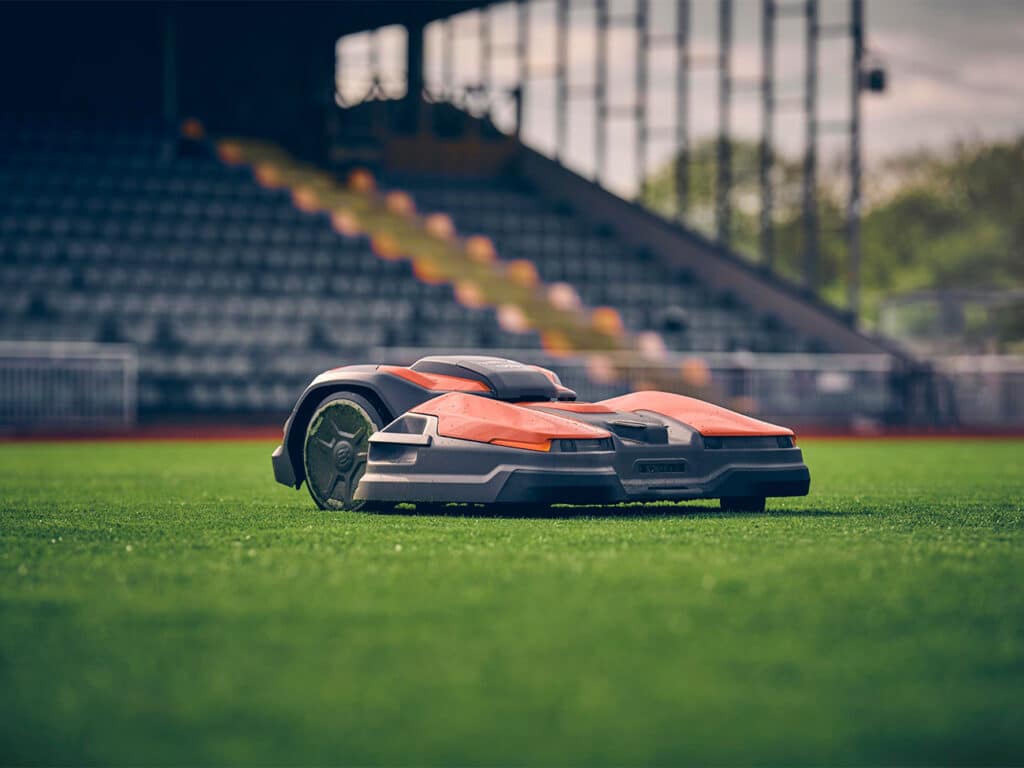
From Husqvarna headquarters in Sweden on June 10, the manufacturer premiered CEORA: a robotic mower tailored to large grass areas. Olle Markusson, director of product management, Pär Forsman, CEORA product manager, and Lars Roos, head of R&D, explained exactly why this mower will revolutionize the industry.
When Husqvarna first launched a robotic mower in 1995, the focus was still on the private individual. “However, as the products evolved, we saw that our robotic mowers were also being used at a more professional level. So it was only logical that we should also focus on a professional target group,” Olle Markusson says.
“Facility managers and operators of sports and golf courses, however, have very specific concerns,” adds Pär Forsman. “For example, they need to be able to keep the turf in pristine condition, but often face either a shortage of qualified staff or a shortage of financial resources to deploy these people with the necessary regularity. In addition, they are pursuing higher and higher levels of sustainability. A quiet, battery-powered solution such as a robotic mower, serves as the perfect solution in that regard. Provided, at least, that it delivers sufficient quality and knows how to handle the large and sometimes complex green areas without problems.”
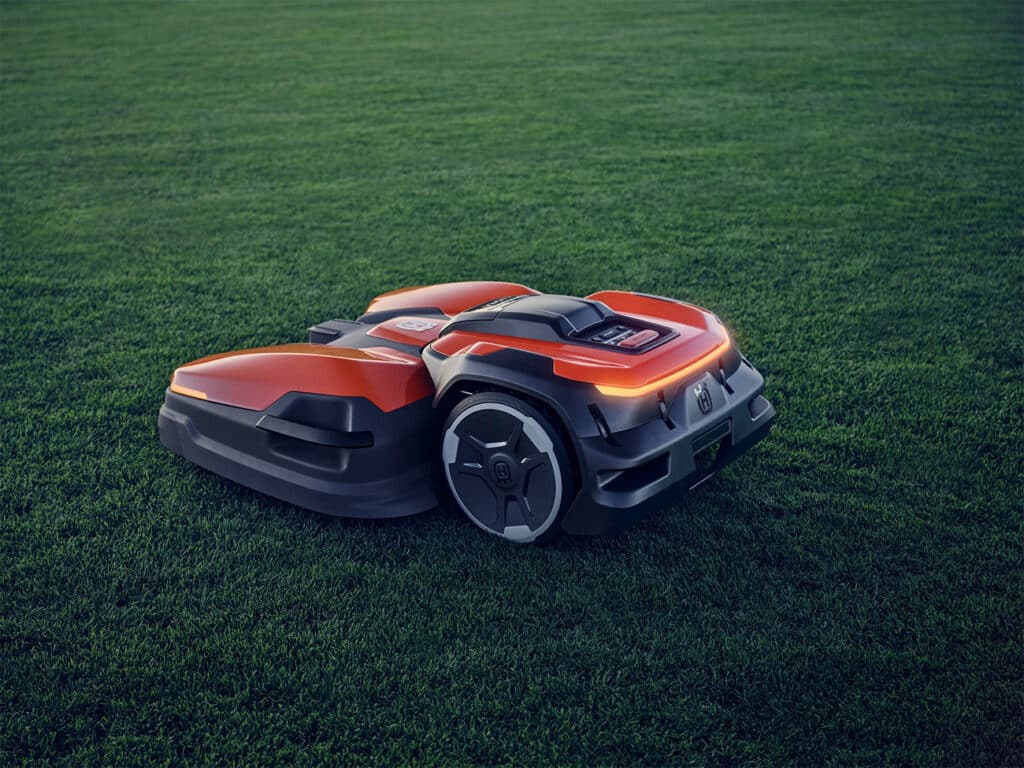
Husqvarna has already had a professional range of robotic mowers since 2018, but it says there was still a gap for large areas. Markusson: “The existing products were suitable for areas up to, say, 5,000 m2; with the CEORA 546 EPOS, that is increased tenfold. In some cases, when the target quality level is somewhat lower, even up to 75,000 m2 can be mowed.”
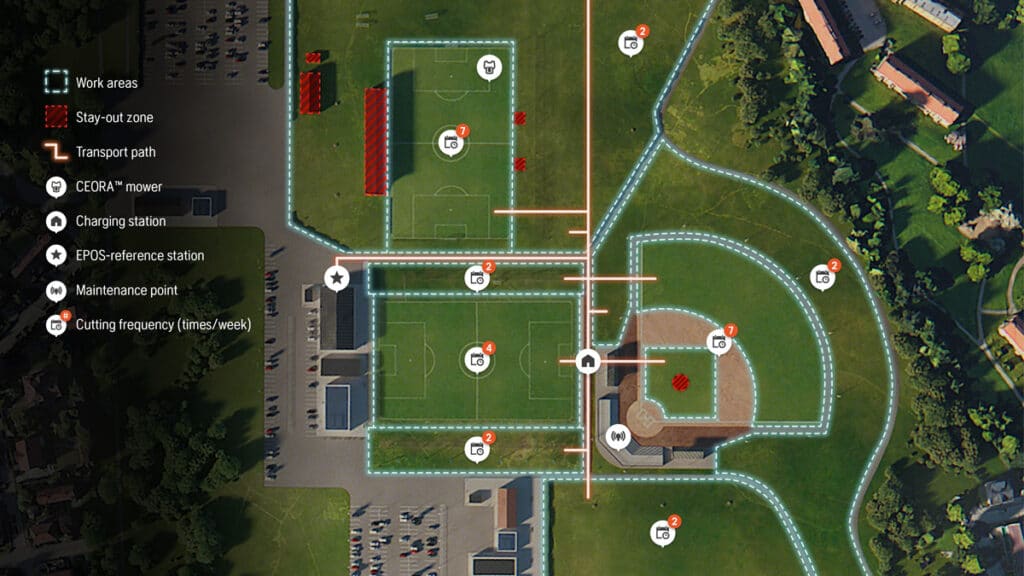
That the CEORA is suitable for such large areas is due in part to the EPOS system. Forsman: “Thanks to this satellite technology, the location of the mower is determined in an extremely precise manner. Among other things, this allows for systematic mowing, where the robotic mower draws parallel lanes and mows with minimum overlap and thus very high efficiency.”
Another asset of EPOS is its flexibility. “The system works without physical boundary wires. All boundaries are entered virtually through the app and can be easily removed or modified when necessary, regardless of how many boundaries need to be drawn and what shape they have. Thus, the system also adapts to more complex terrains.”
Timers and cutting heights can also be set for each zone via the app. Even at night or in the rain, the silent operation and IPX5 protection respectively allow mowing. ’This facilitates frequent maintenance and consequently better results,“ Forsman said. ”This is because regular mowing thickens the turf and causes roots to develop better. In addition, the CEORA is equipped with a cutting deck with three pivoting and ultra-sharp HSS blades. They ensure an exceptionally sharp cut.“
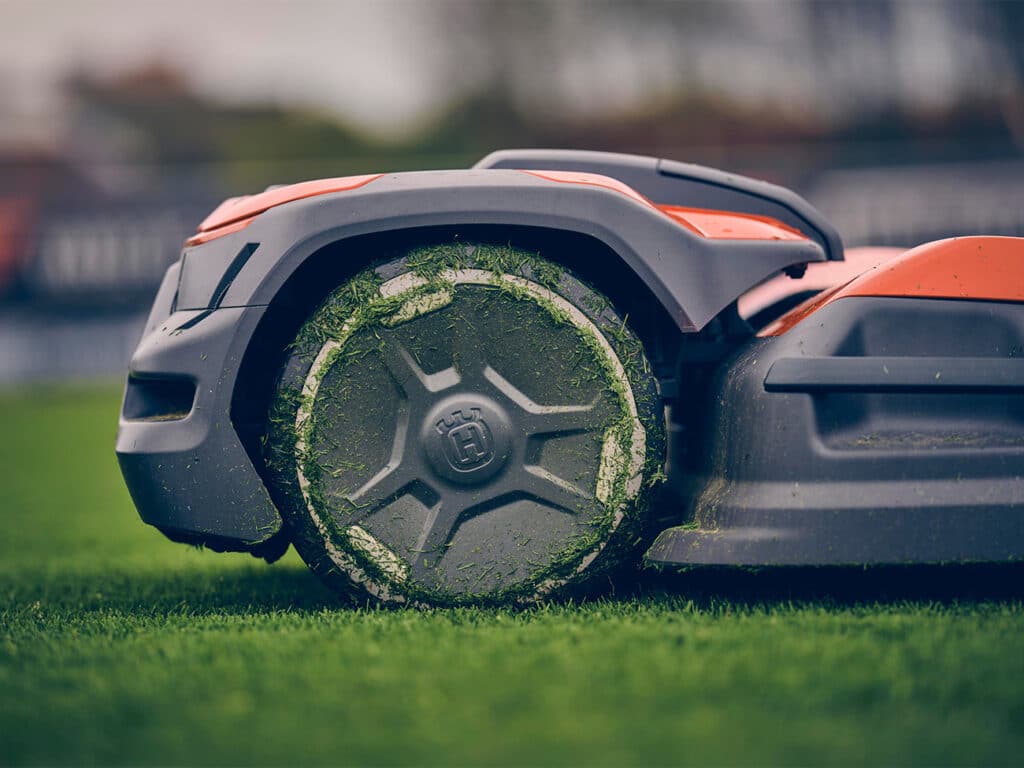
Rotating wheel brushes keep the cutting deck clean and ensure that the cut grass is nicely distributed over the turf. The machine can be cleaned quickly with a jet of water, and when the blades need replacing, it is done in a matter of minutes.
In addition to the current cutting deck, suitable for cutting heights between 20 and 70 millimeters, Husqvarna foresees other options in the future. Lars Roos: “CEORA was developed as a modular multi-tool. Thus, the engine unit and the mower deck can be perfectly disconnected to realize other configurations, for example with a mower deck for shorter or just longer cutting heights, or an engine unit perfectly tailored to the type of terrain. Also at the back of the machine we foresee possibilities for expansion, such as with a roller or a trolley for fertilization. Such things we will continue to develop in the coming years. Since the CEORA is equipped with FOTA (Firmware over the Air), it can in any case be brought up to date with any new update or development without any problems.”