keepitgreen.be
ENG

Platform for soccer and golf course managers.
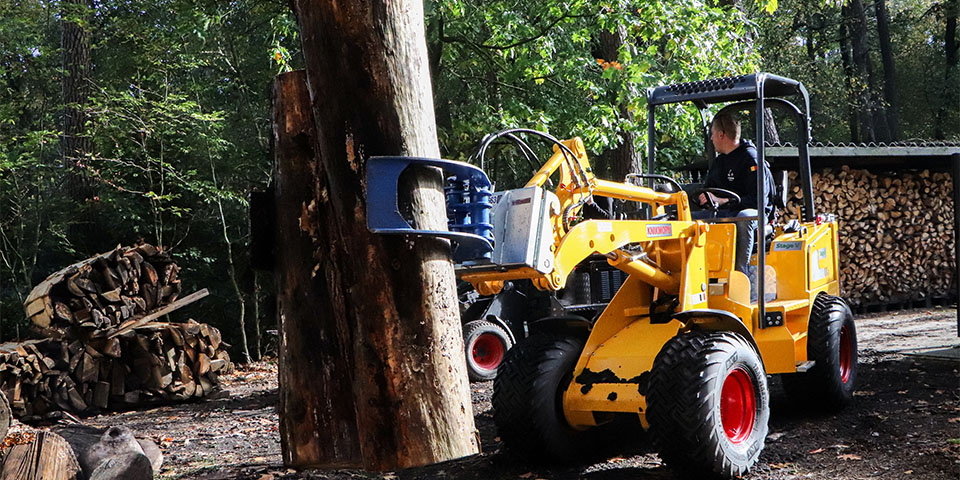
For more than thirty years, the Gebroeders Geens NV factory in Hoogstraten has been designing and producing versatile machines for, among other things, landscaping and paving work. The family business remains loyal to the established values, but also looks firmly to the future. With several new developments, the second generation of Geens strives for sustainable top performance for greener prospects.
The mission of Gebroeders Geens NV has remained unchanged for thirty years: with the now familiar yellow Knikmops, the company wants to literally take the heavy work out of the hands of various contractors. The compact articulated loader is therefore not only characterized by its high demolition force and large lifting capacity, but, with the aid of a wide range of hydraulically driven attachments, it can also be used for the most diverse jobs. Various buckets and mowers, wood splitters, weed brushes, rotary cultivators and levelling frames make the Knikmops an extremely useful machine for garden professionals and others.
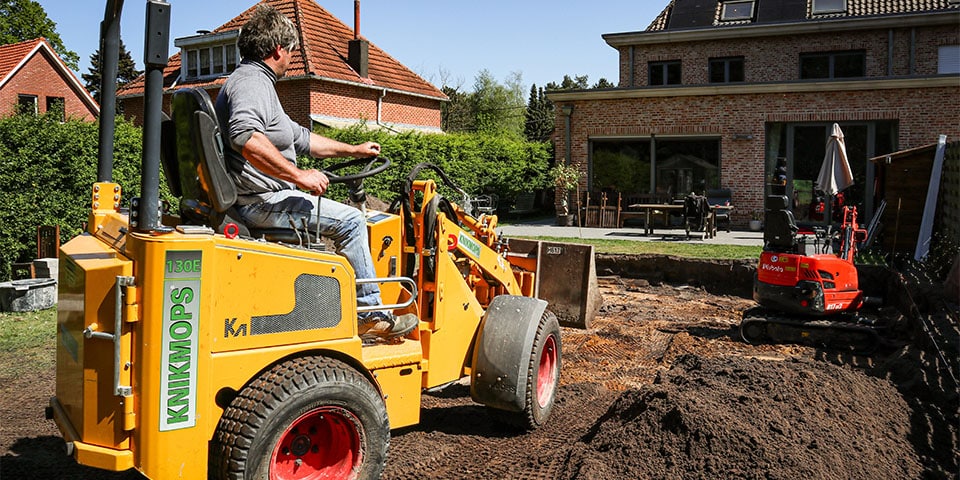
The prototype of the electric Knikmops is already being fully tested. During the construction of this pool, the silent motor already ensures the peace of mind of all local residents.
Like hand tools, however, wheeled and articulated loaders are also not escaping the call for more sustainable performance. The European obligation to only market machines with Stage V diesel engines is steadily approaching, and various manufacturers are already looking for electric alternatives. Gebroeders Geens NV has its own engineering department, which today does everything in its power to bind sustainable drives also to the fixed values of comfort, quality and reliability.
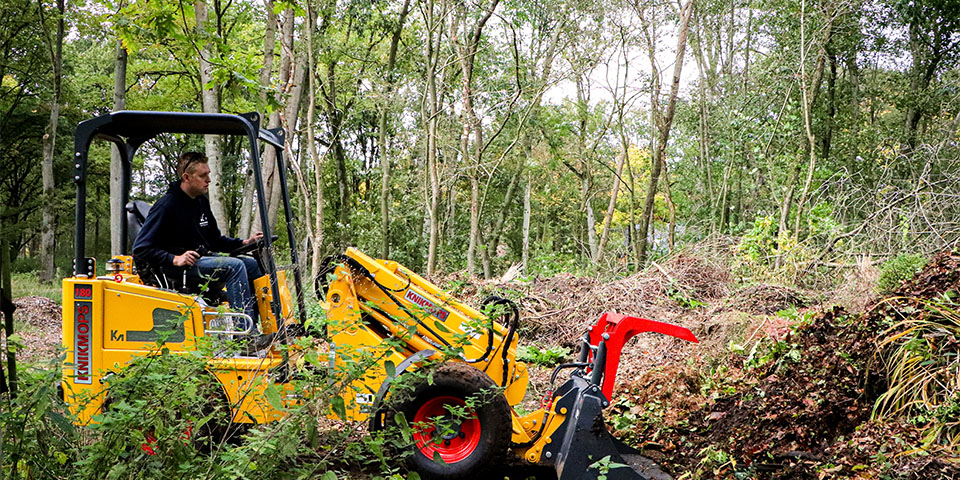
Larger jobs require larger machines, such as the Knikmops 180 TE, here equipped with clawed soil bucket.
To limit emissions from (diesel) engines, Europe has been imposing production standards since the beginning of this century. These are gradually getting stricter, culminating this year in the Stage V standards. Consequence? From 2021, in the class up to 56 kW and above 130 kW, only machines with Stage V diesel engines may be produced. Those engines provide a significant reduction in emissions, but are also generally larger and more complex than their predecessors. "The installation of such an engine requires quite a few adjustments to the machine," knows product specialist Bert Geens. "In order to ensure that the chassis of our Knikmops articulated loaders could remain as compact as possible and that the operator did not have to sacrifice comfort, we therefore took our time to fully fine-tune the engineering."
While the smaller models could continue to be produced with Kubota engines with minor modifications, the upgrade of the larger models proved to be a somewhat more robust challenge. "With the Knikmops 180 and 250, with an output of 33 kW and 36 kW respectively, the smooth installation of the new Stage V engines required more fitting work, for example for the integration of the large particulate filter into our compact chassis. However, with the support of the engine manufacturer, we managed to achieve this as well. Moreover, thanks to the new engines, the machines benefit from extremely good throttle response and quieter operation. The latter in particular is often a decisive point in urbanized areas."
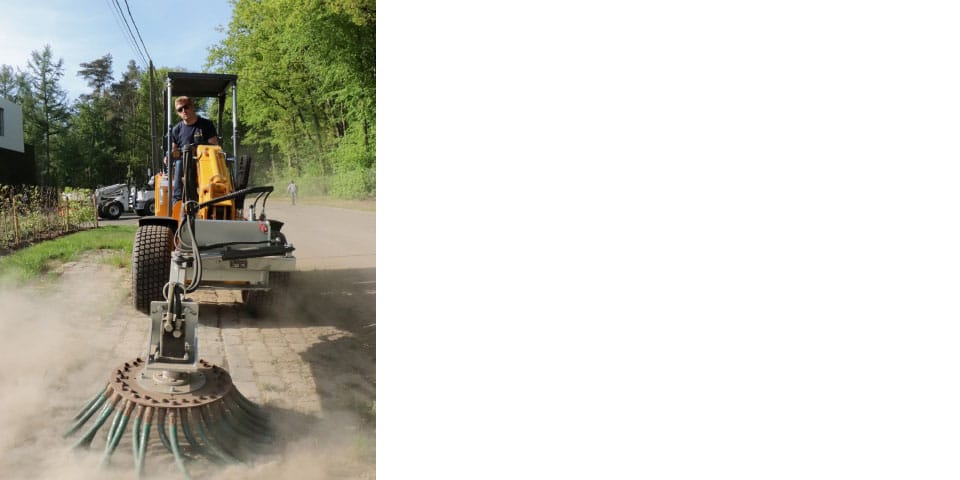
Thanks to the wide range of attachments, such as this weed brush, the articulated loader can be used for a wide variety of tasks.
Even quieter, of course, is an electric motor. "After the auto industry and the hand tools market, voices are also being raised in our sector in favor of further electrification," says communications manager Marleen Geens. "But as in those other sectors, autonomy is also a tricky issue here. If we want to launch a sustainable electric solution, as far as we are concerned, it must be at least as reliable and user-friendly as its diesel-powered counterpart. That means it must be able to provide full-day service."
In the engineering department, two prototypes previously passed the revue for this purpose. "In the meantime, we have worked out a concept that is particularly energy-efficient and can therefore ensure long autonomy even with a limited battery - and thus a relatively limited cost."
"Several of our regular customers are now putting that prototype to the test," continued Marleen Geens. "They are deploying the machine in their daily operations, comparing its performance with that of their familiar diesel-powered Knikmops and providing us with a weekly logbook with detailed data on battery charge, work performed, energy loss, charging time, and so on. In this way we find out perfectly how energy-efficient our electric Knikmops is exactly and how our customers experience the machine. And that, at this point, only hints at a bright future, in which sufficient autonomy is indeed a viable card is."