keepitgreen.be
en

Platform for the management and construction of sports and golf courses
More pitches, less commitment
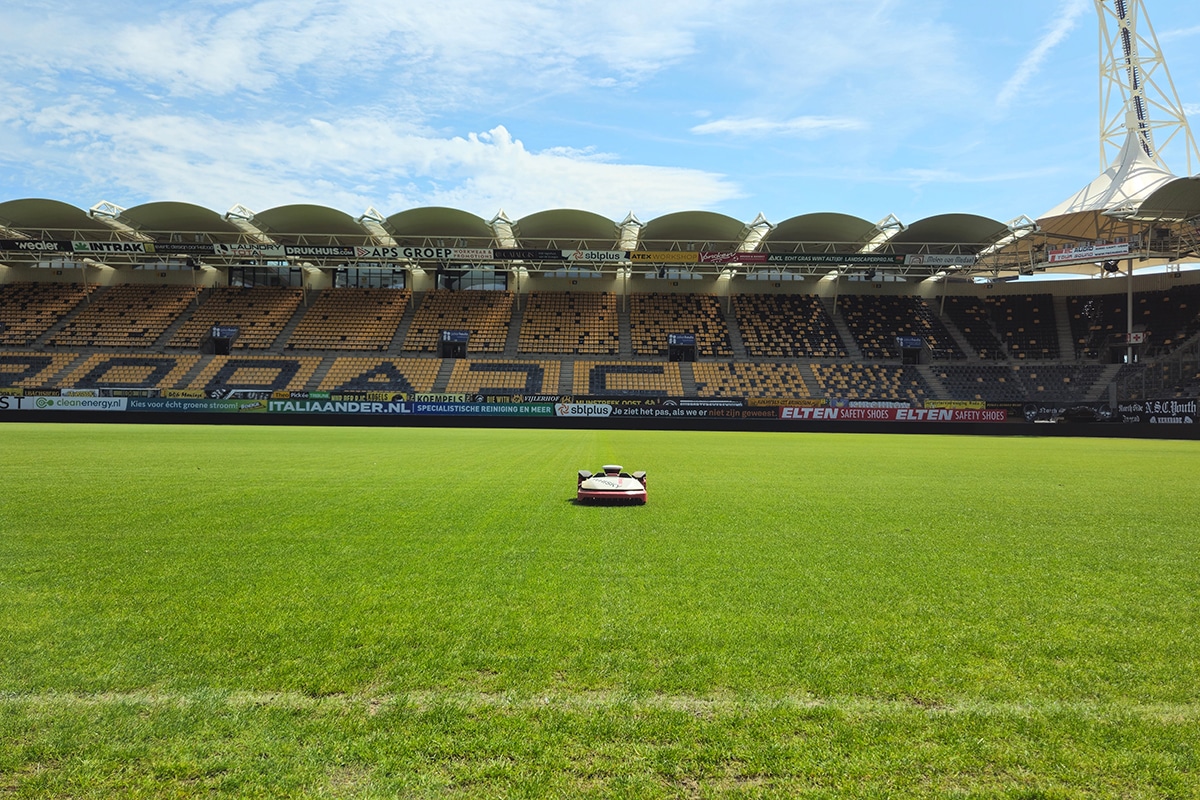
Robotic lawnmowers are today an integral part of the maintenance of gardens, sports grounds and other extensive green spaces. In recent years, the technology has grown into a fully-fledged part of professional management, with Belgian robotics occupying a remarkably strong position. Several users tell how this evolution has dramatically improved their operations.
Domien Lobeau of Lovanhop in Poperinge coordinates a fleet of as many as 80 robotic mowers in West Flanders. “These are mainly used on football pitches and large gardens,” he says. “We once started as hop growers, but gradually specialised in the construction and maintenance of football and sports fields.”
The impact of robot technology is huge. “We used to be able to mow around 45 fields a week using traditional methods. With robots, we can handle up to 100 fields a week, and that with just three permanent employees.” Marking, meanwhile, is also done with a unique robotic solution. Customers have the choice of buying, renting or leasing, while Lovanhop follows up the service. “That support and the Belgian roots were important reasons for us to work with this technology”,
Lobeau said.
In De Haan, sports officer Stijn Bulcke is particularly pleased with the three robotic mowers that have been maintaining the football pitches at sports complex Haneveld for a year now. “Previously, our groundskeeping staff used to mow twice a week with machines that were actually not ideal for sports fields. Robotic mowers can be adjusted much more precisely, which is better for both the playing quality and the turf.”
The switch means employees can now be deployed elsewhere in the municipality to maintain public green spaces.
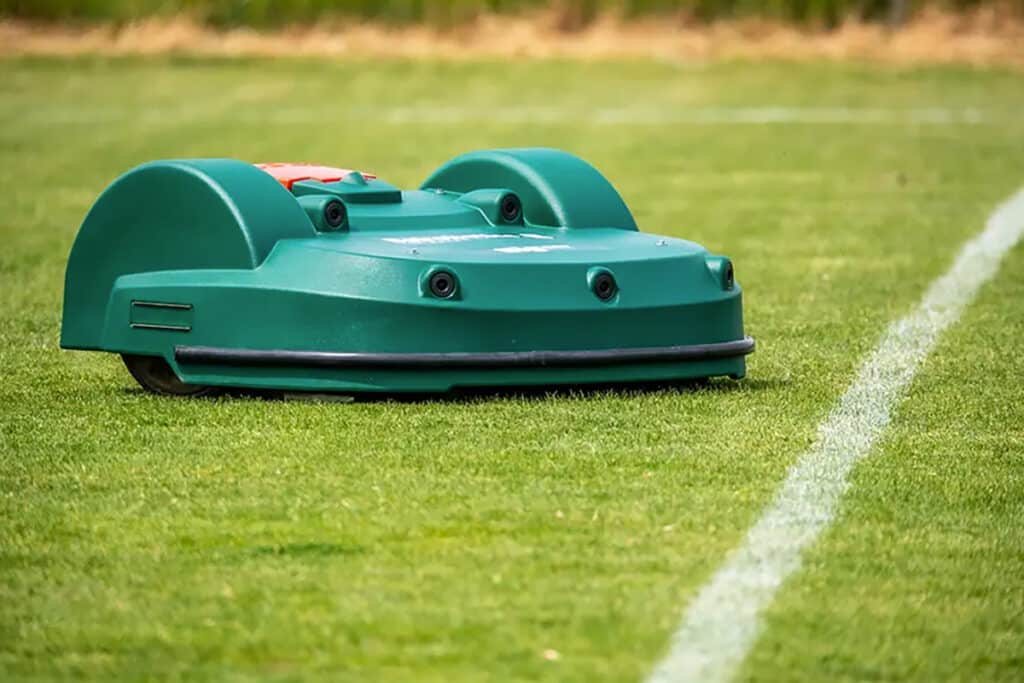
In practice, the technology requires little attention. “The supplier sets the routes and we can monitor everything through an app. Mowing times are tailored to training sessions and competitions. Clubs keep an eye on things and notify us in case of problems.”
With three fields, the robots run intensive hours. “In summer, they mow almost continuously, with short loading moments in between. As long as the field is free of obstacles, they work completely autonomously. There is no need to dispose of grass waste: by mulching, they feed the soil.”
Maintenance proves simple: “After a short explanation from the supplier, our staff can do it themselves: mainly cleaning and replacing blades.”
Bulcke is also positive about the cooperation with Lovanhop. “In case of a breakdown, even something small like a WiFi malfunction, all it takes is one phone call and we get immediate help.”
Please contact us directly at Yamabiko.
 Contact us
Yamabiko Europe is a Belgian subsidiary of Yamabiko. Yamabiko, headquartered in Japan, is a leading multinational in the Japanese and US markets with a growing presence in Europe, Asia and other countries. Yamabiko manufactures and markets hand-held outdoor machines, agricultural machines, industrial machines and Robots. www.yamabiko.eu/nl www.belrobotics.com/nl-be www.echorobotics.com/nl-be
View Company Profile