keepitgreen.be
en

Platform for the management and construction of sports and golf courses
In football, we like to talk about systems, budgets, trainers and transfers. About youth work, about marketing and about perception. But rarely - far too rarely - about the element that every weekend makes the difference between a good game and a frustrating afternoon: the pitch. That sounds obvious, but according to Ivo Zoons of Algrozo, it is precisely that foundation that is still treated as an afterthought in many clubs. And that worries me. Because those who don't take the pitch seriously are sabotaging their own sporting ambitions. It's as simple as that.
No two fields are identical, but the challenges are: too wet, too dry, irregular growth, pests, wear and tear, intensive use, not enough rest. “Climatic conditions play an increasing role,” says Zoons. “One week you almost drown, the next week you get dry patches.” It is the new reality in which both pub teams and 1A clubs have to find their way. But he says the biggest vulnerability lies elsewhere: in the lack of knowledge, resources and follow-up.
Too often, a pitch is still judged by gut feeling. Some find it too hard, others find it perfectly playable. But without measurements, everyone remains stuck in their own right. That is why Zoons sees the recent introduction of measuring devices within the Pro League as an important step forward. “Data makes everything demonstrable: hardness, infiltration rate, stress factor ... you're finally talking about facts, not
about opinions.”
Many clubs are investing in robotic mowers, sometimes hoping they will solve the job. But according to Zoons, this can be dangerous if people do not understand how and when to deploy such a machine. “The most dangerous thing for a robotic mower is dew,” he says. “If it mows when it is too damp, you spread diseases and pests faster.” The maintenance of these robots is also often underestimated. “We see devices running with two blades instead of five. Sure you get problems then. It's like shaving with a blunt knife.” The technology is useful, but not autonomous. It requires monitoring, insight and discipline.
Even the highest series sometimes lack professional field managers who can guarantee continuity and quality. Sporting ambitions grow faster than infrastructure, with all the consequences that entails. “You cannot keep compensating with budget or stopgap measures,” says Zoons. “If the basics are not right, if you intervene too late, you will burn yourself out.” He therefore advocates a change in mentality: every club must see the pitch as the core of its infrastructure. A perfect turf is not a luxury product, but the engine of the game. It determines safety, playability, appearance and even sporting performance.
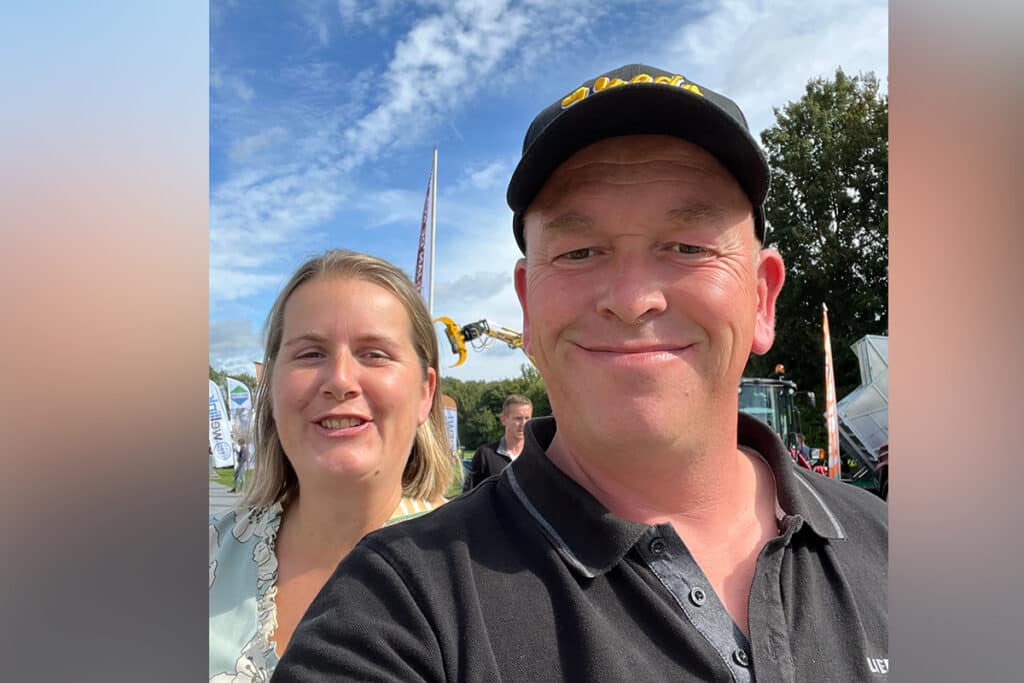
Ivo sons and Sonja Vandevenne, business managers of Algrozo: “You can have nice jerseys, nice shoes, perfect balls ... but without a pitch there is no football.”
Ivo Sons
Managing director Algrozo | Director Algrozo