keepitgreen.be
en

Platform for the management and construction of sports and golf courses

More golfers in Aalst
Since corona, membership increased from 700 to 1,000 at the De Kluizen golf course in Aalst. People not only started walking en masse but also playing golf. Head greenkeeper Joost De Backer enthusiastically gives us an insight into his world.
Head greenkeeper Joost De Backer has already had his first morning reconnaissance. “In summer, we start at 5.30am to get ahead of the golfers. Around 3pm or 4pm, our day job is over.”
As an avid morning and outdoorsman, the job as a greenkeeper was tailor-made for Joost. He started as a job student at the golf club during his secondary studies in biotechnology. He then followed the agro and biotechnology option agriculture. What followed was written in the stars. When the former head greenkeeper resigned, the owner looked towards Joost. “That's how I started working here right after graduation. Meanwhile, we are seven years on,” says
De Backer.
“The maintenance of the nine-hole golf course is quite intensive. The total area is 16 hectares of which eight hectares are used for golf. Meanwhile, we have 1,000 members. The first golfers are on the tee as early as 6am. In winter this is with the rising of the sun and in summer tournaments take place every Friday afternoon, Saturday and Sunday. During the week, competitions are reserved for club members themselves. Thus, it can be very busy. Monday is greenkeepers” day and no tournaments take place," De Backer adds.
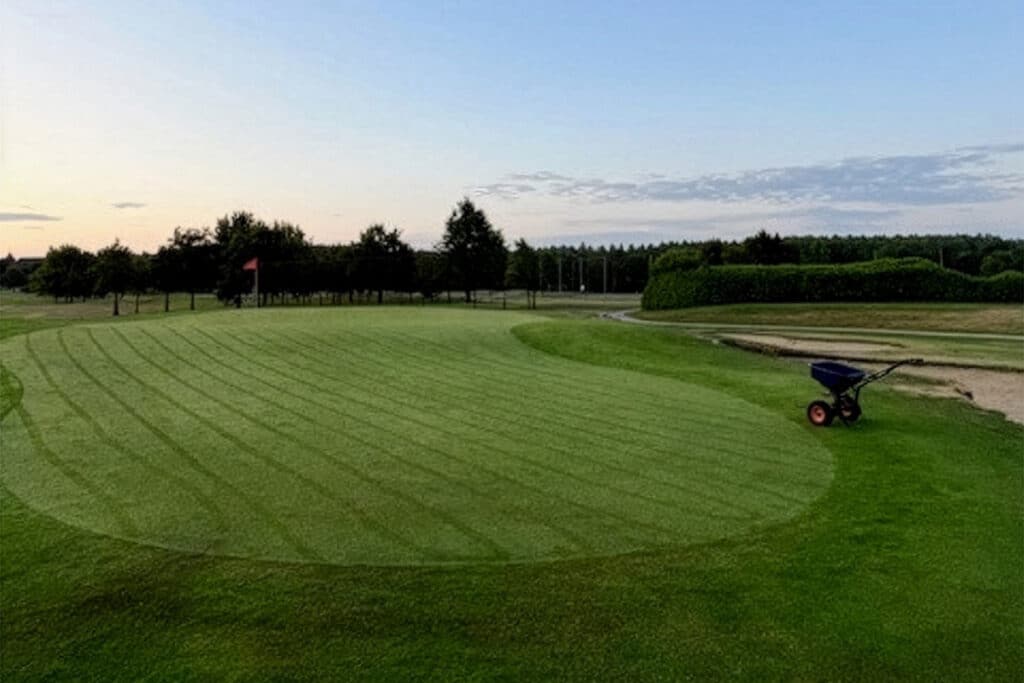
Joost and his team ensure that the turf looks almost perfect all year round. In summer, the greens are mowed every day to a height of 4 mm and regularly pruned and sanded. A spreading machine is used to spread a fine layer of sand over the greens to make the ground more sandy and even. Small pits are filled in to recreate a flat green on which the ball can roll better and faster. “In spring, we take soil samples to determine the fertilisation plan and amounts of nitrogen.”
De Backer continues, “Because the greens are kept very short, we don't suffer from weeds. For the white fungal disease Fusarium that affects the grass, we do have to be careful. The use of pesticides is very limited. We spray only with ferrous sulphate: once a month in summer and every fortnight in winter. Because of the wet summer last year, we were able to do less sanding. As a result, you get a thicker felt layer in the greens so we feel greater disease pressure compared to other years. Responding to dry periods is not so easy. We work with a sprinkler system on the greens, not on the fairways. Sand injection with a top charger involving vertical drainage trenches is a fairly new application.”
“The short-cut fairway (2 cm) is a large flat area of grass, between the tee - the place to tee off - and the green. Around the fairway is the rough, an area where the grass is cut 5 cm high. The aim is to reach the flag on the green from the tee in as few strokes as possible,” explains De Backer.
“When in summer the golf course looks immaculate and members give compliments, I realise again what a fun job this is.”