keepitgreen.be
en

Platform for the management and construction of sports and golf courses
Choosing quality over maximum growth
Nitrogen is the most important nutrient in the management of sports pitches, golf courses, public green spaces and high-quality lawns. It largely determines turf growth rate, colour, recovery capacity and density. Successful turf management, however, is not about achieving maximum growth, but about maintaining a balanced development of leaf tissue, roots and soil biology.
Excessive nitrogen applications can produce undesirable effects. Turf that is continually stimulated to produce rapid leaf growth often develops a shallower root system, becomes more susceptible to drought stress and generally has lower resistance to disease and intensive wear. It also increases the risk of thatch build-up, restricting the movement of water and air through the soil profile. The focus is therefore shifting from maximum growth towards controlled growth, with the aim of producing a strong, sustainable and manageable turf surface.
Nitrate nitrogen (NO3-) is the most readily available form of nitrogen for turfgrass. Because it is easily absorbed with soil water, it quickly produces a visible improvement in colour and growth. This makes nitrate particularly useful for renovation work, overseeding programmes and other situations where a rapid response is required.
However, this high availability also has its drawbacks. Nitrate binds only weakly to soil particles, making it prone to leaching, particularly on sandy soils, intensively irrigated sports pitches and during wet periods. In addition, nitrate primarily stimulates cell elongation. The plant absorbs additional water to maintain salt balance, resulting in longer, softer cells. The outcome is often a deep green turf that looks attractive but is less firm, less wear tolerant and more maintenance-intensive. For this reason, nitrate is generally used as a corrective or supplementary nitrogen source.
Ammonium nitrogen (NH4+-N) is efficiently absorbed by many turfgrass species and is immediately converted into amino acids, the building blocks of proteins. Because ammonium carries a positive charge, it binds to clay and humus particles. As a result, it remains available in the rootzone for longer and presents a lower risk of leaching.
A fertilisation programme based on a higher proportion of ammonium generally promotes stronger root development, improved tillering, denser turf, greater tolerance to drought and stress, and more efficient nutrient uptake. Ammonium also enhances the availability of nutrients such as phosphate, iron and trace elements. On sports pitches, golf courses and fine turf, this approach can also help reduce the competitiveness of annual meadow-grass (Poa annua), allowing the desired turfgrass species to perform more successfully.
Containing approximately 46% nitrogen, urea is one of the most widely used nitrogen fertilisers worldwide. Before its nitrogen becomes available to the plant, however, urea must first be converted into ammonium and subsequently, in part, into nitrate. This conversion depends on soil temperature, moisture levels and microbial activity.
When urea remains on the soil surface for an extended period—for example during dry weather or when irrigation is insufficient—ammonia volatilisation can occur, resulting in nitrogen losses. Urea is therefore most effective when adequate soil moisture is present or when it is irrigated in immediately after application. Urease inhibitors can also improve nitrogen use efficiency.
An increasing number of turf managers are opting for slow-release nitrogen sources such as methylene urea (MU), IBDU and other controlled-release fertilisers. These release nitrogen gradually in line with turf growth and soil biological activity, helping to avoid excessive growth flushes while maintaining more consistent turf development.
The benefits include fewer growth fluctuations, reduced leaching and volatilisation, deeper rooting, more consistent playing quality and lower maintenance requirements. Although these products are often more expensive initially, they can reduce overall maintenance and renovation costs.
Organic nitrogen sources such as lucerne, soybean meal, blood meal and horn meal are also becoming increasingly important. They not only feed the turf but also stimulate soil biology. This supports organic matter development, improves soil structure and contributes to better water management, greater nutrient availability, enhanced thatch decomposition and increased turf resilience.
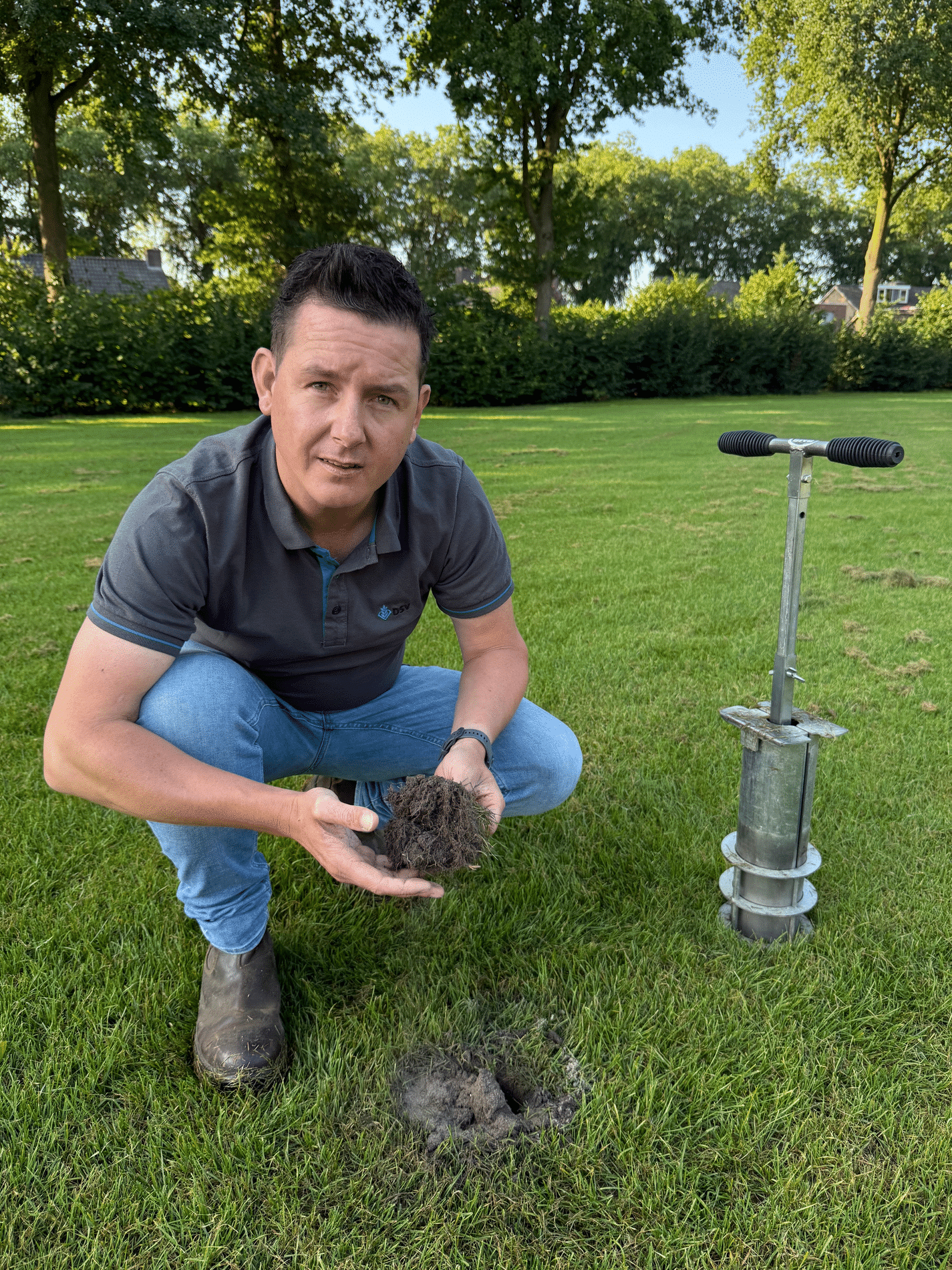
The effectiveness of nitrogen fertilisation depends not only on the fertiliser selected. Healthy soil provides the foundation for efficient nutrient uptake. Compaction, oxygen deficiency, poor drainage and limited microbial activity all reduce the turf’s ability to absorb nutrients while increasing the risk of nitrogen losses. Regular aeration, attention to organic matter and sound water management therefore remain essential.
Soil temperature also plays a key role. Below 6°C, nitrogen uptake is very limited. Root activity begins at around 7–8°C, while nutrient uptake is generally most efficient between 9 and 12°C.
Because annual meadow-grass (Poa annua) typically responds more rapidly to nitrogen than perennial ryegrass or slender creeping red fescue, many golf courses adopt a cautious fertilisation strategy in early spring. Iron applications, biostimulants and soil improvement measures are often prioritised before nitrogen inputs are increased.
Ultimately, successful turf management requires selecting the right form of nitrogen at the right time, based on soil conditions and management objectives. The goal is not the fastest-growing turf, but a turf surface that remains strong, healthy, sustainable and fit for the future.