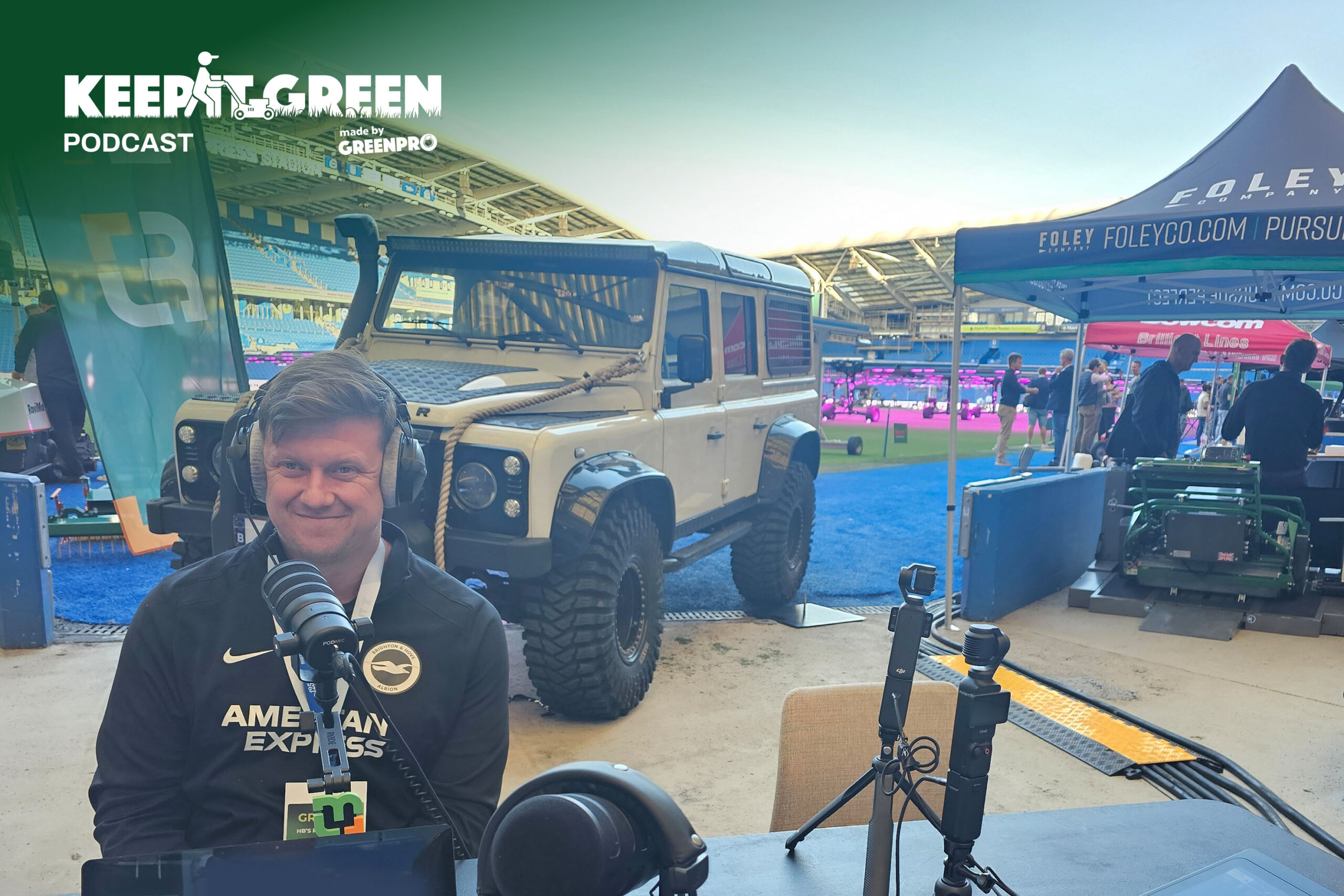
[00:02] Introduction – Keep It Green at TurfTech 2026
Kris Vandekerckhove: Welcome to Keep It Green, the podcast for professionals working at the heart of the turf and green industry. For this special series, we’re recording at TurfTech 2026 in Brighton, bringing together experts, ground professionals, and innovators from across the international sports turf sector. In each episode, we go beyond the surface and dig into the knowledge, technology, and decisions shaping the pitches and playing surfaces of tomorrow. We’re recording this one in the perfect place to talk about stadium microclimates, the Amex itself. Phil Fifield is head groundsperson here at Brighton & Hove Albion and knows every square meter of this pitch better than most of us know our own gardens. Is that correct, Phil?
Phil Fifield: It’s a nice compliment. Thank you very much.
[00:58] Stadium microclimates – Shade, humidity and airflow
Kris Vandekerckhove: So, Phil, people instinctively think shade is like the main problem inside a stadium because you have pieces of the turf that are more shaded than others. Is limited light actually the biggest issue here? Or does humidity and restricted airflow cause you more trouble? Or what does cause you more trouble than shade?
Phil Fifield: I think it’s probably a combination of all the items that you mentioned, depending on the time of the year and the conditions that you’re facing. For us, particularly this time of year, we normally refer to it as the sticky period between summer and autumn. The transition period between that can be quite a challenge. Even last week, we had temperature highs of 27 to 28 degrees and lows of 23, 24 overnight. In the beginning of this week, as we’ve gone into preparations for TurfTech, we’ve had highs of 23 with night temperatures of 21. So it’s been incredibly sticky, really high humidity. Also, that then becomes accelerated with the amount of shade that we have, also encroaching further and deeper across the playing surface as well.
[02:06] LED grow lights and turf fans
Phil Fifield: The main sort of advancement that we’ve had in recent years, how we’ve changed the results that we’ve managed to yield, moving towards LED has allowed us to take giant strides forward at the start of this season. In the past, when we’ve solely relied on HPS grow lights, there’s no way to control the amount of heat which is being released and produced by the bulbs. At least now with LED, we can isolate the amount of heat which is being produced and applied to the leaf, which has given us a much more harmonious growing environment for the pitch. One of the first things that we brought in about five years ago was the use of turf fans. In a way, I was quite fortunate to see some fairly devastating impacts of grey leaf spot on some pitches in the south of France. And from that point on, it was kind of like a head start as to what kind of disease pressure the UK is likely to be facing as temperatures… It’s not just the temperatures, it’s the extremity of the temperatures and the weather patterns that it generates. Nothing seems to be gradual. It seems to be a sudden shift or a sudden spike in conditions.
[03:17] Vulnerable areas of the Amex Stadium pitch
Kris Vandekerckhove: In this particular stadium, do you have areas that are more vulnerable than other parts?
Phil Fifield: It’s a fantastic stadium and it’s aesthetically pleasing. If you’re into your stadiums, it’s a wonderful building. However, parts of the ground are built at ground level, whilst others are a considerable depth below ground level. So the southern area of the pitch sits below those ground levels, receives a minimal amount of light, but also lacks natural airflow and air movement as well. So by creating supplementary airflow, air movement by the turf fans, we’re able to help promote a much healthier growing condition for the plant, avoid periods of prolonged leaf wetness as well. But again, probably the greatest asset I have is the staff. So, in the summer, if they see any risk of leaf wetness during high periods of humidity and stress, they’ll be dew brushing two, three, four times a day. They’ll be dew brushing shortly after midday irrigation. The irrigation that we do put down is heavy and full early in the morning once humidity is at its lowest. So it’s maximising the opportunities that you have to get the works done correctly at the right time.
[04:35] Combining data with practical groundskeeping experience
Kris Vandekerckhove: And it’s because you’re working with a lot of data, and this pitch is actually looking gorgeous. Congratulations for that. And your team, of course.
Phil Fifield: They’re not that gorgeous, the team. I’ll pass it on there.
Kris Vandekerckhove: The pitch. Anyway, you’re working with, like, it’s still nature. So you’re working with data and technical stuff, but it’s still nature and it’s still climate and weather and humidity. Are there, like, occasions when doing nothing is the better intervention?
Phil Fifield: I’d say nothing’s done by chance. Everything’s carefully monitored and measured. We are quite data-led in how we plan and how we review the works that we’re doing and the conditions of the pitch. But equally, I need the guys that I work with to be able to read the pitch, read the conditions, assess the leaf in real-time visuals when they’re working on the pitch and daily checks as well. It’s great to have the data to be the vehicle that drives some of your decision-making, but equally you need dedicated people that can interpret that data effectively and put plans into place to ensure that the data and the pitch condition is actually aligned with what you’re hoping to achieve.
[05:48] Interpreting pitch performance data
Kris Vandekerckhove: That was actually my next question. It leads perfectly to that because indeed you collect a lot of pitch performance data here. You must have had a situation where the numbers challenged what your experience was telling you. Because you have a lot of experience, of course.
Phil Fifield: Again, it’s how you look at data as a collective rather than individually. So you may find yourself in a position where firmness may be a little bit higher, but force reduction, energy restitution is more favourable. So it’s how each parameter can support the playing characteristics next to it. It’s not really looking at one thing in isolation, it’s looking at everything as a complete review.
[06:35] High standards and communicating with club management
Kris Vandekerckhove: You are a team of groundsmen. The pitch has to be perfect every time they play on it because the players, well, demand that, and there’s a lot of money involved. We’re not going to talk about money, of course, but how do you explain to management what needs to be done?
Phil Fifield: I think the pressure side of it and the demand is actually internal. It comes from within. I think myself and the staff, we have an incredibly high level of standards that we want to achieve every single time. The pitch performance data that we take from the pitch is then relayed to the club, the coaching staff, head of performance, head of medical, to allow them to get an inside view of what the pitch will be like when they come to play on it. And also, I want to know how every inch of that pitch is going to perform on a weekend as well. So there are many key stakeholders that benefit from the pitch system that we do. And we want to be able to provide the best service as we can to as many people at the club to ensure that, as a collective, we’re in a very strong position to perform well.
Kris Vandekerckhove: I understand.
[07:38] Playing performance versus visual appearance
Kris Vandekerckhove: Brighton has come a long way, so now it’s Premier League. Premier League football is unforgiving because a pitch has to perform as well as look perfect for television. We all know it. When the two objectives conflict, which one wins?
Phil Fifield: I’d say typically when the pitch looks well, it’s typically in a good place as well. It’s a tricky question to answer, to be honest with you. We don’t really find ourselves in too many positions where the two conflict. I’d like to think if we find ourselves in a position where there could be those areas of concern, that we’d have addressed them early on to try and minimise the risk as early as possible.
[08:20] Behind the scenes – The work required to maintain the pitch
Kris Vandekerckhove: We stand here beside, well, the pitch of the football team, but it’s a little bit your pitch as well, of course. What is the one thing most people looking at the pitch would never realise you are constantly fighting and working for? What is behind the scenes to get it like this?
Phil Fifield: I think in the past it would be like the before-mentioned humidity, shade. And I’m very fortunate the club have been very supportive and understanding of our own goals and what we’re hoping to achieve on the pitch as well. And ultimately, we want the best playing surface that we can give any of our teams that play here, the men’s first team, the women’s first team, the 21s, and the youth teams when they get the opportunities to play here in the cups as well. So it’s a fantastic club to work at, and I’m really glad that we share the same levels of ambition. It makes life a lot easier when you both want the best that you can possibly produce. And again, I think a lot of the improvement has been… I don’t think the pitch particularly gets better every year, but I think the people that work on the pitch get better every year because at the end of every season, everybody that I work with, all they talk about is how can we be better next season as individuals, as a team, as a pitch, you know. And everyone is so, so driven to be the best version of themselves and to be better again next season. And it is good to have that competitiveness and that drive to improve every year.
[09:50] Matchday pressure and the grounds team’s perspective
Kris Vandekerckhove: Now you’re one of those groundsmen, Phil, that looks at the game, and every time one of the players takes a slide, and you see the grass floating around, your heart bleeds a little bit because you know what you have to do to make it perfect again.
Phil Fifield: I don’t mind it so much. I think it normally performs pretty well. I’m not trying to encourage knee-slide celebrations or something. It’s, I don’t know. I mean, the pitch is there to be played on, and it plays an important role in what we’re trying to achieve on a matchday. Once the ref blows the whistle, we go up to the office for the first 10, 15 minutes and just watch the pitch on the TV to see how it looks and make sure we’ve hit those visuals for a matchday. And then I’ll be back with the guys watching the rest of the game from the pitch side. But it’s been a massive adventure and a great journey. And I’m grateful to share it with the people that I work with.
[10:52] Closing – Keep It Green at TurfTech 2026
Kris Vandekerckhove: Thank you so much, Phil.
Phil Fifield: It was a pleasure. Thank you.
Kris Vandekerckhove: That was a great talk. You’ve been listening to Keep It Green from TurfTech 2026 in Brighton. Thanks for joining us. You can find more conversations, articles, and insights from the events on the Keep It Green website and our social channels. Until next time, thank you, Phil.